Keys Where Fruit Should Be
This is a complete report, shown exactly as it is delivered — nothing shortened, nothing left out.
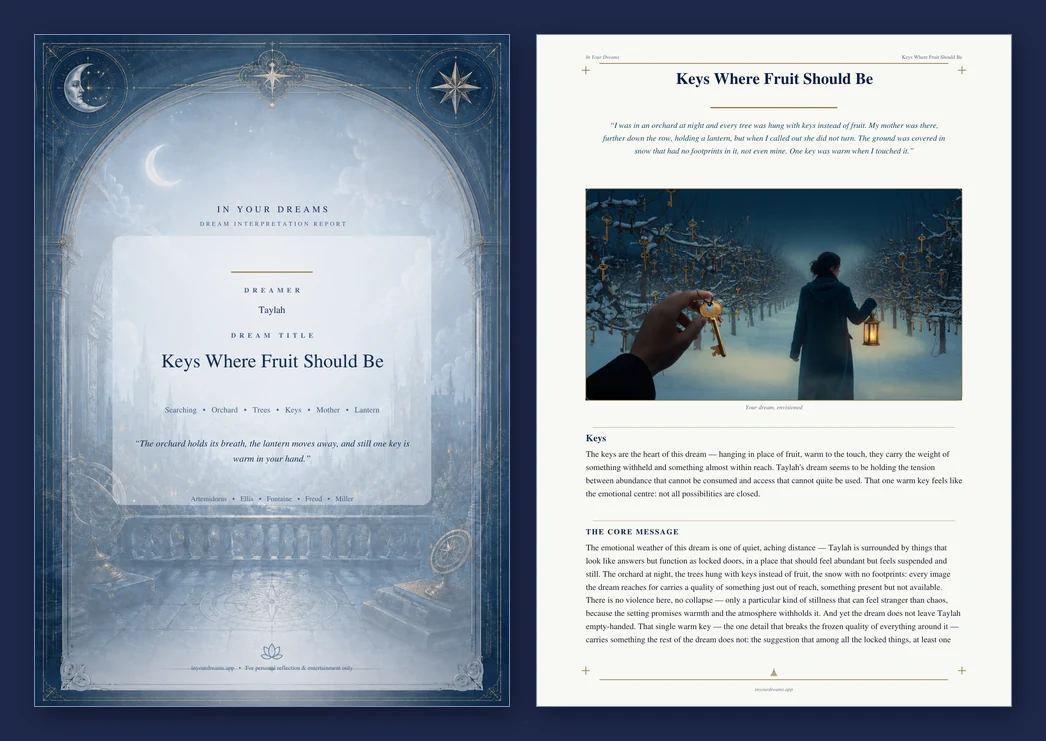
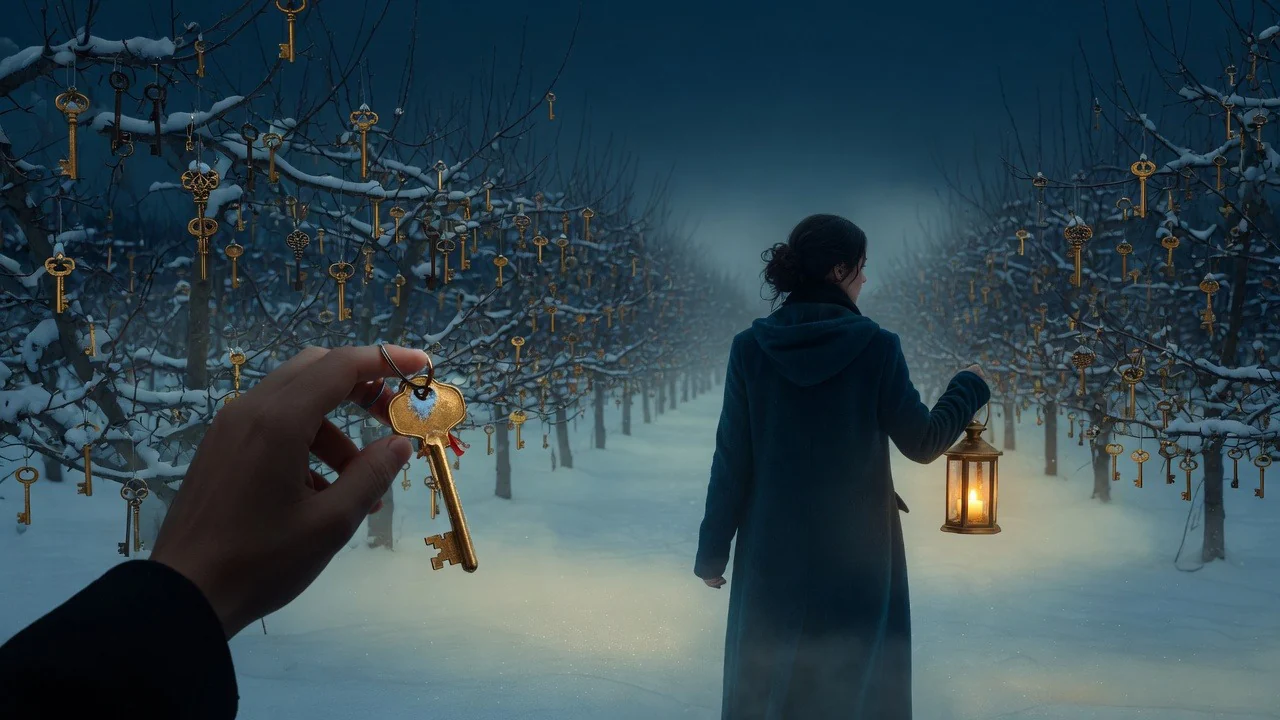
Keys
The keys are the heart of this dream — hanging in place of fruit, warm to the touch, they carry the weight of something withheld and something almost within reach. Taylah's dream seems to be holding the tension between abundance that cannot be consumed and access that cannot quite be used. That one warm key feels like the emotional centre: not all possibilities are closed.
🌙 The Core Message
The emotional weather of this dream is one of quiet, aching distance — Taylah is surrounded by things that look like answers but function as locked doors, in a place that should feel abundant but feels suspended and still. The orchard at night, the trees hung with keys instead of fruit, the snow with no footprints: every image the dream reaches for carries a quality of something just out of reach, something present but not available. There is no violence here, no collapse — only a particular kind of stillness that can feel stranger than chaos, because the setting promises warmth and the atmosphere withholds it.
And yet the dream does not leave Taylah empty-handed. That single warm key — the one detail that breaks the frozen quality of everything around it — carries something the rest of the dream does not: the suggestion that among all the locked things, at least one may respond to her touch.
🪞 The Emotional Undercurrent
What the dream seems to be working with most deeply is the particular feeling of calling out and not being heard — or of being heard but not answered. Taylah calls to her mother, and her mother does not turn. The lantern is there, the figure is there, the light is there, and still the turning does not come. That moment carries a weight disproportionate to its simplicity, the way small gestures in dreams sometimes carry feelings too large for the image that holds them.
The snow without footprints adds another layer to this: not only is connection unavailable, but there is no trace of how Taylah arrived here, no evidence of the path that brought her. Dreams sometimes use images like these when the feeling being processed is one of disorientation — not knowing how one got to a particular moment in life, or standing in a familiar landscape that no longer quite responds the way it used to. The warmth of that single key feels like the dream's quiet insistence that not everything is cold and unreachable — a small but real point of contact.
📖 What the Sources Reveal
Beginning with the orchard: Miller's 1901 dream dictionary has a detailed reading here, and it is worth sitting with several of its registers rather than collapsing to one. Miller reads an orchard visited with a romantic partner as the promise of ‘a delightful consummation of a long courtship,’ and an orchard ‘filled with ripening fruit’ as recompense for faithful effort and ‘full fruition of designs.’ But Taylah's orchard carries no ripening fruit — it carries keys. Miller also reads a barren orchard as signalling that ‘opportunities to rise to higher stations in life will be ignored,’ and an orchard robbed of its verdure as suggesting ‘carelessness of the future in the enjoyment of the present.’ None of these map perfectly onto Taylah's dream, which is not quite barren — it is differently occupied.
Fontaine's 1862 dream-book links the orchard to ‘some pleasant adventure either of love or intrigue’ when the fruit looks fair, but to ‘mean and low company’ and disgrace when the fruit is scraggy or rotten. It is important to hold Fontaine's harsher readings as period folklore rather than anything carrying forward as prediction — these are snapshots of how mid-nineteenth century American fortune-telling literature spoke, not forecasts for Taylah's life.
Artemidorus, the oldest of these dream-books, writing in the second century AD, reads fruit broadly: ripe, sweet fruit as ‘a good time and joyfulness,’ while fruit that is sour or out of season signals ‘noise and sedition’ or ‘travail and labor in vain.’ His framework is ancient and reads through the social world of classical antiquity, so it should be held lightly — but as a deep pattern, it reinforces the tradition's consistent concern with whether the fruit of one's efforts is truly ready to be gathered.
The trees themselves: an 1894 fortune-telling dream-book associates flourishing trees with happiness and success in one's undertakings, while Fontaine links green and flourishing trees to ‘riches,’ noting the larger the trees, the better the fortune suggested. Neither source, however, specifically catalogues trees hung with keys in place of fruit — the substitution is not addressed in these historical entries, and it would be dishonest to map either reading directly onto Taylah's unusual image.
Turning to the lantern: Miller reads a lantern seen going before someone in darkness as signifying ‘unexpected affluence,’ though ‘if the lantern is suddenly lost to view, then your success will take an unfavorable turn.’ He also reads carrying a lantern as a sign that ‘your benevolence will win you many friends.’ In Taylah's dream, the lantern is not hers — it belongs to her mother, who moves away. Miller does not address a lantern held by another person who does not respond; that particular configuration is not in the entry.
On the mother: Miller reads seeing one's mother as she appears in the home as signifying ‘pleasing results from any enterprise.’ But the dream's emotional material here asks for careful handling. Dreams of loved ones who do not respond — who are present but unreachable — are doing emotional processing work, not forecasting. The dream is working with something about connection and distance in a relationship that carries real feeling; it is not pointing toward any event in that person's life or in Taylah's.
The snow is not directly catalogued as a standalone symbol in the entries available here. Artemidorus does address snow, noting that seen out of its natural season it is ‘onely good for plowmen, to others not, for it argues that their business shall go forward coldly.’ But his snow is about conditions and timing — it is not about snow without footprints, which is Taylah's particular and striking detail. That absence of trace, the erasure of arrival, is not catalogued in our historical sources and it would be wrong to invent a reading for it.
Finally, the keys: Fontaine links finding a key or bunch of keys to being told a secret, while losing keys is read as predicting shame — harsher framing that should be received as the period folklore it is. No other source in our dictionary entries directly catalogues keys as a dream symbol. The warmth of a single key — Taylah's most distinctive sensory detail — is not addressed by any of these historical sources, and it deserves to be held as the dreamer's own experience rather than assigned a borrowed meaning.
✦ Guidance & Reflection
What Fontaine and Miller and the 1894 tradition agree on — even through their different tones and their period fatalism — is that orchards and trees and fruit are consistently read as spaces where potential and effort meet their moment of reckoning: either the fruit is ready or it is not, either the orchard is flourishing or something has come to interrupt it. Taylah's dream suspends that reckoning in an unusual way, replacing the fruit with keys — not absence, but a different kind of presence. It may be worth sitting with what in Taylah's waking life feels similarly suspended: full of potential that has not yet opened into anything she can actually hold or consume.
And that one warm key is worth returning to. Among all the cold and still things, the dream gave Taylah one thing that responded to her touch — and that detail belongs entirely to her, uncatalogued by any historical source, waiting for her own interpretation of what, right now, feels like it might actually be within reach.
📜 The Sources, In Their Own Words
These are the entries our historical dream-books record for the symbols in this dream, in their own words, transcribed from the original editions, archaic spelling and all. Read them as period voices, not predictions.
To dream of seeing a lantern going before you in the darkness, signifies unexpected affluence. If the lantern is suddenly lost to view, then your success will take an unfavorable turn. To carry a lantern in your dreams, denotes that your benevolence will win you many friends. If it goes out, you fail to gain the prominence you wish.
Dreaming of passing through leaving and blossoming orchards with your sweetheart, omens a delightful consummation of a long courtship. If the orchard is filled with ripening fruit, it denotes recompense for faithful service to those under masters, and full fruition of designs for the leaders of enterprises. Happy homes, with loyal husbands and obedient children, for wives.
To see your mother in dreams as she appears in the home, signifies pleasing results from any enterprise. To hold her in conversation, you will soon have good news from interests you are anxious over. For a woman to dream of mother, signifies pleasant duties and connubial bliss.
To dream of trees in new foliage, foretells a happy consummation of hopes and desires. Dead trees signal sorrow and loss. To climb a tree is a sign of swift elevation and preferment. To cut one down, or pull it up by the roots, denotes that you will waste your energies and wealth foolishly.
If, in your dream, you imagine you are in a fine orchard, and the fruit looks fair and tempting, and you eat of it, it foretells that you will shortly be engaged in some pleasant adventure either of love or intrigue: if you see rotten, wormy, or scraggy-looking apples, it shows that you will be thrown into mean and low company, much to your disgrace.
To dream of green and flourishing trees is an excellent omen, as it foretells riches—the larger the trees, the better the fortune: if you dream of climbing into a high tree, you will not only be rich, but will come to great distinction.
If you dream of finding a key, or a bunch of keys, it is a sign that some one will tell you a secret; to dream of losing a key, or keys, is a bad omen, as it predicts that you will come to shame.
🏛 The Tradition Behind Your Reading
In Your Dreams draws on a library of primary dream-texts spanning nearly two thousand years. Which of these voices appear in any given report depends on the symbols your dream contained.
His Oneirocritica is the oldest surviving systematic work on dream interpretation, the foundation on which the entire Western tradition was built.
An anonymous Victorian dream-book in the popular fortune-telling idiom of its day: a window into how ordinary people of the period read the language of their dreams.
The Golden Wheel Dream-book, an old American fortune-teller's guide. Its readings are blunter and more fatalistic than later works, so we present them as period folklore, never as prediction.
Ten Thousand Dreams Interpreted, the most comprehensive dream dictionary of its era and the backbone of this report's symbol readings.
The Interpretation of Dreams, which reframed dreams as meaningful expressions of inner life rather than omens, shaping how this report treats emotion as the dream's true signal.
An early and careful student of the dreaming mind, whose emphasis on the dreamer's own emotional reality guides how each reading is framed and kept grounded.
Your dreams already know the way.
Your dream is not this dream
This reading is specific to one person's night. Yours would be written for the dream you actually had, with its own image, drawn from our historical dream-text library, and kept in a journal that remembers every dream you log. Over time that record shows you the patterns no single reading can: which symbols return, and when.
Interpret my dream →